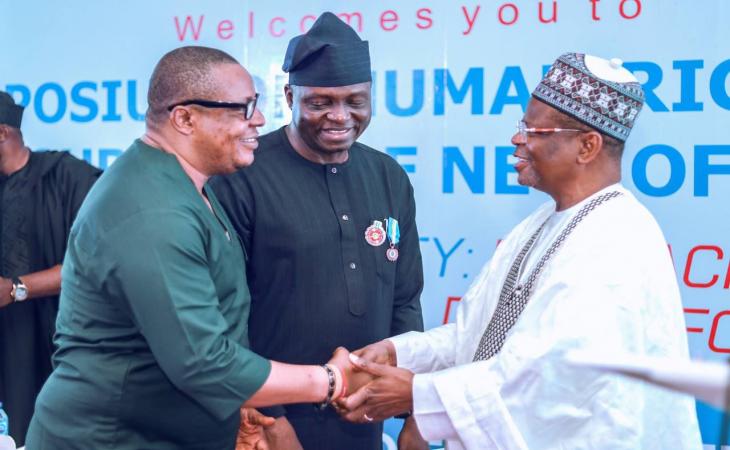
…With Theme: Unity in Diversity, Embracing Freedom, Equality and Dignity for All
In commemoration of the 2024 International Human Rights Day on December 10, 2024, the International Human Rights Commission (IHRC) Transitional Intergovernmental Organization held a Symposium with the theme, Unity in Diversity, Embracing Freedom, Equality and Dignity for all as well as inauguration of new members into its Board on Wednesday, 11th of December, 2024 in Abuja, Nigeria.
In his welcome address the host of the event and the Diplomatic Head of Mission IHRC-NIGERIA, Amb. Dr. Duru Hezekiah said this was not the first time of holding the International Human Rights Day but this year is a unique one because they were inaugurating 4 distinquished Nigerians into the Board of the International Human Rights Commission, Transitional Intergovernmental Organization.
Dr. Hezekiah said Unity, Freedom and Equality were very vital in managing Nigeria's diversity. He noted that "EQUITY" was the number 1 point in the Universal Declaration of Human Rights, He said that without Freedom, Equality and Diversity Nigerians will not feel safe to live and work in parts of the country that are not their places of origin. He noted that Nigeria is a multicultural and multiethnic country with over 250 ethnic nationalities.
Ambassador Hezekiah said tha the IHRC's 2025 Project is titled: Impacting People all over Africa and Nigeria. He said the project is aimed at getting to the roots of the real people in the rural areas. He said they will not go through government agencies but will rather go through our traditional institutions with our traditional rulers and the Ambassadors of the process.
"We want to reach the grassroots through our traditional fathers/rulers. Anything that will start with them will get to the grassroots. Healthcare, etc. Our budget is huge. We will go hrough the Emirs, Obas and we will succeed.
The eminent Nigerians who were inaugurated are as follows:
1. Ambassador Dr. Malami Shehu Ma'aji MFR was inducted as IHRC Special Advisor on Intergovernmental Affairs for Africa Region. With this appointment, Ambassador Malami Shehu Ma'aji assumed the chairmanship of the IHRC Advisory Board in Nigeria.
2. Dr. Kingsley Nwokoma is the president of The Association of Foreign Airlines and Representatives in Nigeria (AFARN) based at Murtala Mohammed International Airport, Ikeja, Lagos. Dr. Nwokoma is a seasoned aviator and can be described as one of the most outstanding experts the Nigerian nation prides with. He has taken his rare knowledge in this strategic sector to the pinnacle, where it has brought meaningful development and contribution in restoring dignity to the aviation sector. 2. He was inducted as an Advisory Member of the International Human Rights Commission in Nigeria.
3. Dr. JohnPaul Ochemba, a staunch advocate of social justice, has made significant strides in both his professional and philanthropic endeavors. Dr. Ochemba's dedication to community service and philanthropy has garnered him numerous accolades. In 2023, he received an Honourary Doctorate Degree from Institute of Leadership Assessment and Development(ILAD), recognizing his outstanding contributions to leadership and social development. He was also inducted Advisory Member of the International Human Rights Commission in Nigeria.
4. Prof Mike Ozekhome, SAN ids a Constitutional lawyer, Human Rights Activist, Pro-Democracy Campaigner, Commander of the Order of the Niger (CON), Officer of the Federal Republic (OFR), Professor of Constitutional Law, Senior Advocate of Nigeria (SAN(, Senior Advocate of the Masses (SAM), Social Critic, Public Affiars Analyst, Pro Masses Advocate, Knight of Students, Voice of the People amongst numerious Acronyms. He is aptly described as a student, lover of law, philosophy, logic, sociology, classics, literature, public ffiars, history, good governance, and the scriptures and has a way with words. He was inducted as an Advisory Member of the International Human Rights Commission in Nigeria during the Symposium.
In his address, Professor Mike Ozekhome noted that he gave a keynote address in September 2023 on the occassion of the International Human Rights Day, titled, International Humanitarian Law and Armed Conflicts, an African Perspective. He said he was surprised when he was called again to give a Keynote address this year because he expected another prominent Nigerian to have been invited to give this year's Address.
Ozekhome thanked Amb. Duru Hezekiah, Ambassador-At-Large/Head of Diplomatic Mission of the IHRC in Nigeria for giving him another opportunity to give an address which he said is his own way of encouraging Amb. Hezekiah for the good works he is doing in Nigeria. Following a parable by his late father that, "a good soil that is good for plants, will always be returned to", Ozekhome went ahead to deliver his Keynote Address titled, "THE POWER OF DIVERSITY: BUILDING A NIGERIA OF FREEDOM, EQUALITY AND DIGNITY,
In his Keynote Address Professor Ozekhome said that Nigeria's ethnic and linguistic diversity is mirrored across other African nations, with countries such as Egypt, Sudan, Kenya, and Tanzania also exhibiting significant pluralism. For instance, Nigeria has 374 ethnic groups and 521 languages, while Sudan has 500 ethnic groups and 600 languages. This diversity, however, can lead to severe consequences if left unmanaged.
"NIGERIA IS ONLY ONE OF THE MANY AFRICAN STATES THAT SHARE HER PLUARLISM
Nigeria's ethnic and linguistic diversity is mirrored across other African nations, with countries such as Egypt, Sudan, Kenya, and Tanzania also exhibiting significant pluralism. For instance, Nigeria has 374 ethnic groups and 521 languages, while Sudan has 500 ethnic groups and 600 languages. This diversity, however, can lead to severe consequences if left unmanaged. Across Africa, unresolved ethnic and political differences have fueled conflicts and wars, resulting in immense loss of life. Notable examples include the Rwandan genocide (1974), the Biafran war in Nigeria (1967-1970), and ongoing tensions in Cameroon since 2017. Other conflicts, like those in Sudan, South Sudan, Mali, and Ethiopia, illustrate how ethnic, linguistic, and political divisions can lead to widespread violence and destabilization. These examples highlight the dire consequences of not addressing such differences effectively.
Prof Ozekhome said the Federal Character Principle (FCP), which was introduced in 1979, was meant to ensure a balanced representation of Nigeria’s diverse ethnic and regional groups in public service. Despite its good intentions, it has often been criticized for creating inefficiencies and perpetuating tribalism, as recruitment is based on state of origin rather than merit.
Ozekhome analyzed the merits and demerits of the Federal Character Principle. In his conclusion, he said that the Federal Character Principle, as currently implemented, has contributed to the creation of a system where mediocrity often triumphs over merit, and the diversity it was intended to manage has instead led to fragmentation. While the FCP was designed to address issues of ethnic and regional disparities, its application has often created more problems, including further entrenching regional loyalties at the expense of national unity. "To move forward, Nigeria needs to replace the FCP with a system based on merit and equal opportunity, fostering sustainable unity and equitable national development. Additionally, a more genuine form of federalism must be adopted to ensure fairer governance and the effective management of Nigeria's diversity. Only through these changes can the nation truly begin to embrace its diversity in a way that contributes to peaceful coexistence and national prosperity.
Panelist who discussed the presentation by Prof Mike Ozekhome are as follows, Dr. Usani U. Usani, Former Minister of Niger DAelta Affiars; Bosede Eitokpah, Gender and Inclusion Expert; Dr. Sueiman Barnabas, Head of Department of Sociology, Baze University, Abuja; Dr. Irene Awunah Ikyegh, President, The League of Women Voters of Nigeria (NILOWV); Dr. Emily Ikhide, Head Gender and Incusivity Unit, National Institute for Legislative and Democratic Studies; Pascaline Ogechukwu Udegbunam, Researcher, The Abuja School of Social and Political Thoughts was Moderator.