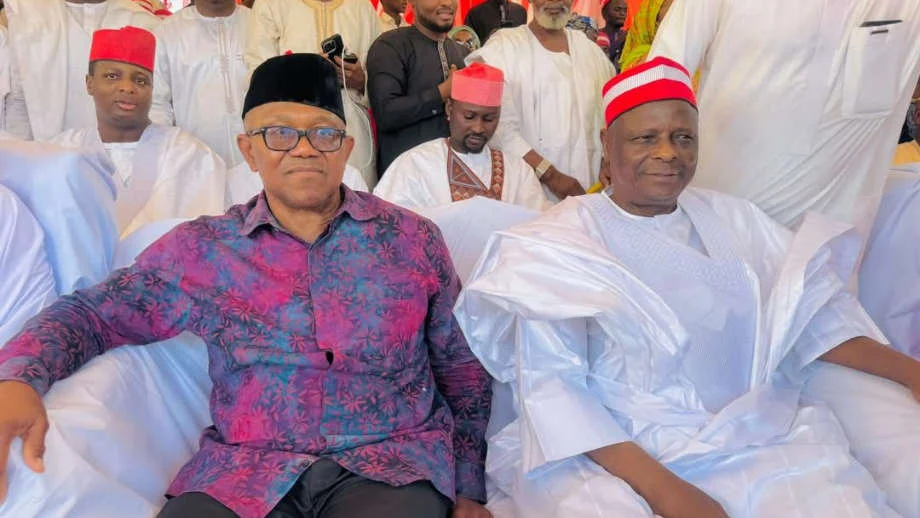
The rift between the Nigeria Democratic Congress, NDC, and the Obi-Kwankwaso Movement, popularly known as the OK Movement, widened on Wednesday as the movement vowed to retain its independent structure ahead of the 2027 general elections.
The Director-General of the OK Movement, John Ughulu, said the group will not collapse or surrender its national, state, local government and ward structures to the NDC or any other organisation.
Ughulu was responding to comments by the NDC National Leader, Seriake Dickson, on the role of support groups in the party's 2027 campaign.
Dickson, who spoke at the unveiling of former Secretary to the Government of the Federation, Babachir Lawal, in Abuja on Tuesday, had said support groups should complement and not compete with the political party or operate as parallel structures.
He described the decision of the OK Movement to set up a presidential campaign council as "unheard of" and "nonsensical," noting that while the NDC will work with support groups, they must operate within their proper roles.
But Ughulu faulted Dickson's position, arguing that the OK Movement is not a conventional support group.
"For the avoidance of doubt, the OK Movement is not a support group created as an appendage of any political party or another movement. It is independently organised, managed and structured through its own established movement mechanisms," he said.
He stressed that the movement is made up of members from different political parties who share a commitment to the ideals of its presidential candidate, Peter Obi, and his running mate, Rabiu Kwankwaso.
According to him, politics has evolved beyond the conventional system, and establishing its own campaign and mobilisation structures is within its rights.
"The OK Movement remains an independent organisation. Its existence and internal administration are not subject to the internal management of the NDC. Cooperation and political alignment do not extinguish the independent identity of the movement," Ughulu said.
He maintained that the movement's organisational structure remains its property and will not be surrendered to any party or external group for management.
Ughulu also dismissed claims that the movement is seeking to usurp the powers of the NDC, but warned against any attempt to take over its structures.
"We respect the NDC and recognise the constitutional authority of the party over its own internal affairs. Equally, the NDC and every other organisation must recognise the independent identity, structure and legitimate interests of the OK Movement.
"We will resist, through lawful and democratic means, any attempt by any individual or group to disenfranchise members of the movement, appropriate its structures, or unilaterally redefine its identity. We did not build the OK Movement overnight," he added.
The dispute followed the NDC's dissociation from a 59-member presidential campaign council constituted by the OK Movement to mobilise support for Obi and Kwankwaso.
NDC National Chairman, Moses Cleopas, had said the party did not authorise the movement to constitute a campaign council in its name, warning that no individual or support group can establish a campaign structure on behalf of the party without approval from its National Working Committee.
In response, the National Secretary of the OK Movement, Saadatu Sani, demanded an apology from Cleopas, insisting that the movement is an independent political organisation with its own leadership and internal processes.